The purchase price gets all the attention during a sale, but the running cost decides whether the machine pays for itself. Buyers ask the same question in plain words: once it is on the floor, what does an hour of cutting actually cost me? This guide breaks that hour into its parts, electricity, gas, consumables, maintenance, and labor, and puts the totals for 3 kW, 6 kW, and 12 kW machines side by side.
If you are still comparing purchase prices, start with Сколько стоит станок для лазерной резки?. This page picks up where that one ends: the cost of every hour after delivery.
Electricity by Wattage: 3 kW, 6 kW, and 12 kW
Fiber lasers are efficient. Manufacturers quote wall-plug efficiency above 35 percent, reaching around 50 percent on some sources, against roughly 10 to 20 percent for older CO2 лазеры. But the laser source is only part of the load. The chiller, fume extraction, servo drives, and control cabinet all draw power whenever the machine is running.
| Мощность лазера | Typical Total System Draw | Куда это идет | Electricity per Hour at $0.15/kWh | Измерения |
|---|---|---|---|---|
| 3 кВт | Около 15 кВт | Roughly 10 kW source plus 5 kW chiller | Примерно 2.25 долларов США | Metered kWh across a full shift |
| 6 кВт | Примерно от 25 до 30 кВт | Source, chiller, fume filter, drives and control cabinet | Примерно от 3.75 до 4.50 долларов США | Average draw, not nameplate capacity |
| 12 кВт | Примерно от 40 до 50 кВт | Larger source and chiller dominate the load | Примерно от 6.00 до 7.50 долларов США | kWh per beam-on hour from the utility meter |
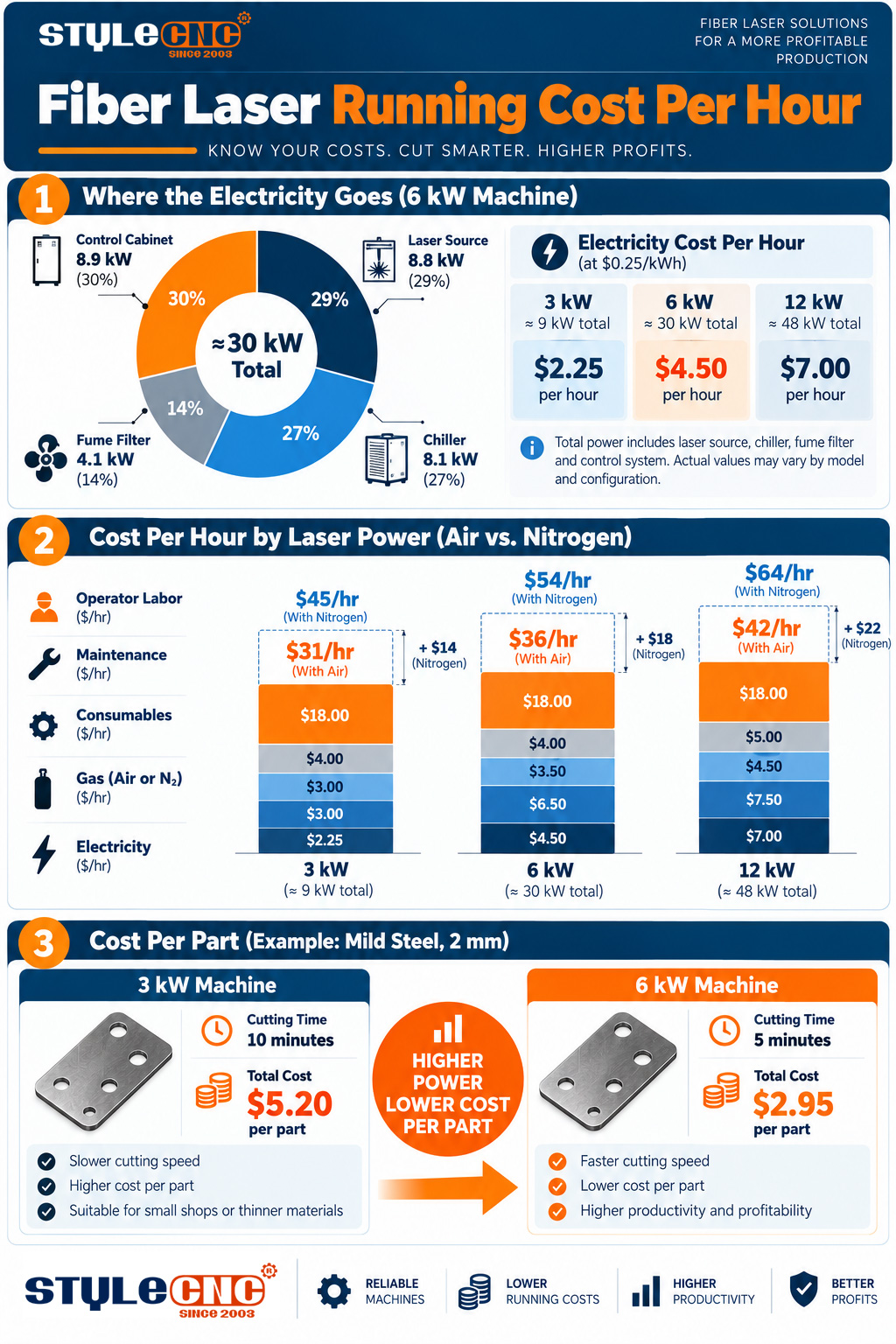
One published 6 kW machine specification illustrates the split well: about 8.8 kW for the laser source, 8.1 kW for the chiller, 4.1 kW for the filter, and 8.9 kW for the electrical panel, for an average total near 29.6 kW. A 3 kW system lands near 15 kW, about 10 kW for the source and 5 kW for the chiller.
• Nameplate or installed capacity overstates the real draw; one 12 kW machine lists 49.4 kW installed, but the source rarely runs at full output all hour.
• Multiply average kW by your tariff: at $0.15 per kWh, a 6 kW machine drawing 30 kW costs about $4.50 per hour.
• Idle time still costs money, because the chiller and extraction keep running between jobs.
How your tariff changes the picture
Electricity prices vary several-fold between regions, so the same лазерная машина для резки металла can cost very different amounts to power. At $0.08 per kWh, a 6 kW system drawing 30 kW costs about $2.40 an hour; at $0.30 per kWh it costs about $9. Demand charges on commercial tariffs can add more if the machine, compressor, and other equipment all start at once, which is worth checking with your utility before installation.
Even at the high end, electricity rarely tops the list. That surprises buyers moving from CO2 lasers, where power was a major line, and it is a of the reasons fiber lasers took over sheet metal cutting.
Потребление газа Assist
Gas is where running costs swing the most. The same machine can cost a few dollars an hour or more than twenty, depending on which gas the job needs and at what pressure.
• Compressed air: mostly the compressor’s electricity, roughly $0.01 to $0.03 per cutting minute, or about $1 to $2.50 per hour.
• Oxygen: used for thicker mild steel at low pressure, typically in the middle of the range.
• Nitrogen: high-pressure cutting for bright stainless and aluminum edges, often $0.20 to $0.40 per cutting minute, or roughly $10 to $25 per hour.
Higher-power machines use larger nozzles and higher flow on thick material, so their gas cost per hour rises. Their cost per part often falls anyway, because they finish the cut faster. The cutting speeds behind that trade-off are mapped in the fiber laser cutting metal thickness, speed, and power guide.
Gas cost also depends on how it is supplied. Bottles and cylinder bundles carry rental and delivery charges on top of the gas, bulk liquid tanks lose some product to boil-off, and on-site nitrogen generators or compressors trade a monthly bill for an upfront purchase. When you calculate gas per hour, divide the whole invoice, including rental and delivery, by beam-on hours, not just the line for the gas itself.
Consumables: Nozzles and Protective Lenses
Consumables are small items with a steady appetite. The ones that wear in normal cutting sit right at the end of the beam path:
• Nozzles: damaged by spatter and collisions; replaced whenever the orifice loses its round shape.
• Protective windows: the cover glass that shields the focusing lens; changed as soon as spatter or contamination shows.
• Ceramic rings: hold the nozzle and carry the height-sensing signal; crack after collisions.
• Focusing and collimating optics: long-lived when the protective window is changed on time, very expensive when it is not.
For most shops these add roughly $1.50 to $3 per beam-on hour, rising with thick plate and piercing-heavy work. Knowing where each part sits in the cutting head, explained in Основные части станка для лазерной резки волоконным лазером, makes it easier to spot wear early. Keeping spares on the shelf from a source of laser machine parts and consumables avoids paying for downtime while waiting on a nozzle.
2 habits cut consumable spend more than any supplier discount. Accurate h8 sensing calibration prevents the nozzle crashes that take out nozzles and ceramic rings together, and checking the protective window at every shift start catches contamination before it heats up and damages the focusing lens behind it. A spotless window costs a few dollars; a burned focusing lens costs far more and stops production.
Труд и техническое обслуживание
Labor is usually the single largest hourly cost, and it does not change with laser power. A loaded operator wage, including taxes and benefits, often runs $20 to $40 an hour depending on region. Automation such as load and unload towers spreads one operator across more machine hours, which is often where the biggest savings sit.
Maintenance covers chiller coolant and filters, rail and rack lubrication, extraction filter changes, and periodic service visits. Fiber sources themselves need little routine work compared with CO2 resonators, but the rest of the machine still does. Most of the cost is prevented by daily habits, set out in the daily maintenance guide for fiber laser cutting machines, rather than by repairs.
Why shift pattern matters
Many maintenance and service costs are fixed per year, so their cost per hour depends on how many hours you run. A $3,000 annual service budget is $2 an hour on a single shift of 1,500 hours, but about $1 an hour on 2 shifts. The same logic applies to the chiller and extraction running through idle time: a busy, well-loaded machine spreads those costs across more cut parts.
Cost-Per-Hour Table
The table combines the lines above for 3 common power levels. The figures are illustrative, assuming $0.15 per kWh and a $25 loaded operator rate; replace each line with your own numbers.
| Cost Line (per beam-on hour) | 3 кВт | 6 кВт | 12 кВт | Измерения |
|---|---|---|---|---|
| Электричество | $2.25 | $4.50 | $7.00 | Metered kWh × your tariff |
| Assist gas: compressed air | $1.00 | $1.50 | $2.50 | Compressor kWh while cutting |
| Assist gas: nitrogen | $15.00 | $20.00 | $25.00 | Gas invoices ÷ beam-on hours |
| Nozzles, protective lenses, ceramics | $1.50 | $2.00 | $3.00 | Parts used per month ÷ hours |
| Техобслуживание и сервис | $1.50 | $2.50 | $4.00 | Annual service spend ÷ hours |
| Operator labor (loaded) | $25.00 | $25.00 | $25.00 | Wage plus taxes and benefits |
| Total on air | $31.25 | $35.50 | $41.50 | Sum of lines using air |
| Total on nitrogen | $45.25 | $54.00 | $64.00 | Sum of lines using nitrogen |
2 things stand out. First, doubling laser power raises the hourly cost far less than it raises cutting speed, which is why a 12 kW machine often produces cheaper parts than a 3 kW machine on medium and thick plate. Second, the gas choice moves the total more than the wattage does. A 6 kW machine cutting on air costs less per hour than a 3 kW machine cutting on nitrogen. Shops weighing those trade-offs often find that high-power fiber laser metal cutting machines earn back their higher running cost through throughput.
Cost Per Hour vs Cost Per Part
Cost per hour is the input; cost per part is what decides profit. Picture a job that takes 10 minutes of cutting on a 3 kW machine and 5 minutes on a 6 kW machine, both on air. Using the table, the 3 kW machine spends about $5.20 on running costs for that job, while the 6 kW machine spends about $2.95, despite its higher hourly rate.
That is why experienced buyers compare machines on cost per part at their real thicknesses. A higher hourly cost is often the price of a much lower cost per part, especially on plate above a few millimeters where the speed gap between power levels widens.
• Thin sheet under 2 mm: speed gains flatten, so a mid-power machine is often the most economical.
• Medium plate around 4 to 10 mm: higher power usually wins clearly on cost per part.
• Heavy plate: only higher power cuts at a practical speed, so the comparison is about capability, not running cost.
How to Measure Your Own Hourly Cost
✔ Meter the machine, chiller, and compressor for a full week and divide kWh by beam-on hours.
✔ Divide monthly gas invoices, including tank rental, by beam-on hours for each gas.
✔ Log nozzles, protective windows, and ceramics used each month.
✔ Add annual service contracts, filters, and coolant, divided by yearly hours.
✔ Add the loaded operator rate, then compare cost per part rather than cost per hour when choosing a machine.
Choose the Power Level That Lowers Your Cost Per Part
Compare power ratings, chillers, and gas options across the full range of станки для лазерной резки волокна, and get a free quote with an operating cost estimate for your materials and hours.