What Is Sustainable CNC Manufacturing?
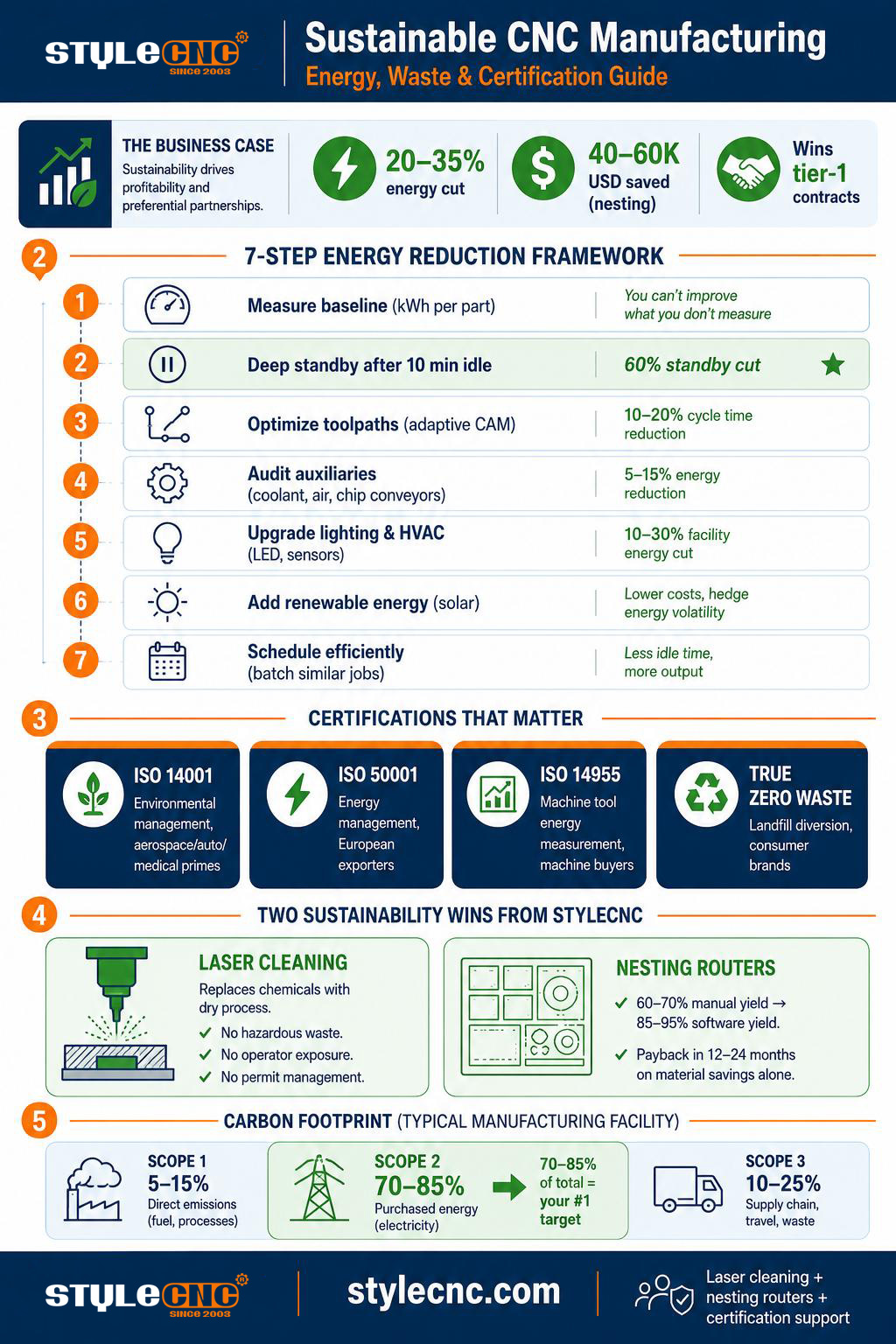
CNC shops reduce energy consumption by measuring baseline usage, activating deep standby modes, optimizing toolpaths, auditing auxiliary systems (coolant pumps, air compressors), upgrading lighting and HVAC, adding renewable energy, and scheduling similar jobs in batches. A typical program cuts total energy use by 20 to 35 percent within 12 months.
Sustainable CNC manufacturing covers 3 main levers: energy efficiency, material waste reduction, and process chemistry. An average machining center draws 15 to 50 kilowatts, enough to run 300 to 1000 light bulbs continuously. Small operational changes on that baseline compound quickly across a fleet of machines.
The business case has shifted. Suppliers with credible sustainability programs win contracts that used to go to lower-cost competitors. TRUE Zero Waste certification has been directly linked to millions of dollars in new business at midwestern job shops. The direction of travel is clear: sustainability is now a commercial lever, not just a cost.
The 7-Step Energy Reduction Framework
This framework is drawn from published CNC energy efficiency research and real shop implementations. The steps are ordered by cost of implementation, from measurement (nearly free) to renewable energy investment (substantial capital).
STEP 1: Measure Your Baseline
Экшн: Run an ISO 14955 machine tool energy measurement or install current sensors on major machines and auxiliary systems. Track kWh consumed per part.
Типичное воздействие: Reveals where 80 percent of your energy actually goes. Often surprising.
STEP 2: Activate Deep Standby
Экшн: Program machines to enter deep standby mode after 10 minutes of inactivity. Disable non-essential circuits (spindle warm-up, coolant recirculation) during standby.
Типичное воздействие: Cuts standby energy consumption by up to 60 percent across the fleet.
STEP 3: Optimize Toolpaths and Cutting Parameters
Экшн: Use adaptive machining CAM strategies. Reduce roughing feed rates by roughly 15 percent where cycle time permits. Eliminate air cuts.
Типичное воздействие: Reduces spindle energy per part by 9 to 12 percent, cuts idle time by up to 20 percent.
STEP 4: Audit Auxiliary Systems
Экшн: Coolant pumps, air compressors, chip conveyors, and mist collectors add 15 to 35 percent to the machine's electrical load. Install interlocks so they run only when machines are cutting.
Типичное воздействие: Common finding: chip conveyors run 100 percent of the time instead of 20 percent needed.
STEP 5: Upgrade Lighting and HVAC
Экшн: Switch to LED lighting with motion sensors in low-traffic areas. Recommission HVAC to match actual shift patterns rather than 24/7 операции.
Типичное воздействие: Typical facility electric bill drops 8 to 15 percent.
STEP 6: Add Renewable Energy
Экшн: Rooftop solar sized to cover daytime machining load. Payback is often 5 to 8 years at industrial electric rates.
Типичное воздействие: Documented case: 50 kW solar array covered 35 percent of daytime energy at a small-batch shop.
STEP 7: Schedule for Energy Efficiency
Экшн: Batch similar jobs together to reduce setup and idle time. Route work to your most energy-efficient machines first. Run energy-intensive operations during off-peak utility rate windows.
Типичное воздействие: Cuts total energy cost 10 to 20 percent through smarter scheduling alone.
Waste Reduction: Nesting, Material Yield, and Scrap Recovery
Energy is only half of the sustainability equation. Material waste is the other half. Traditional CNC processes generate significant scrap, and aerospace machining still runs buy-to-fly ratios as high as 20:1 on titanium parts, meaning 95 percent of the starting material becomes chips.
3 practical waste-reduction levers are available to almost any shop. First, nesting software optimizes how parts are laid out on sheet stock to minimize offcut. Second, material yield tracking measures actual scrap rate per job and drives improvement. Third, chip recovery programs sell aluminum, steel, and copper chips back to the material stream instead of landfilling them.
The waste reduction case pairs neatly with the energy case: cutting fewer parts to hit the same output means fewer machine hours, which means less energy consumed. Sustainability KPIs and productivity KPIs converge in practice.
Scrap recovery programs deserve specific attention because they turn a cost into a revenue line. Aluminum chip revenue can offset 3 to 8 percent of raw material cost when segregated and sold to a metals recycler. Copper and stainless commands higher prices. The catch is segregation: mixed chip streams sell for a fraction of pure-material rates, so shop-floor discipline matters more than the machinery involved.
Coolant management is a 3rd overlooked lever. Coolant recycling systems extend fluid life 3 to 5 times, reducing both purchases and hazardous waste disposal. Modern high-pressure through-tool coolant delivery uses less total fluid than flood cooling while improving chip evacuation and tool life.
Chemical-Free Processes: Laser Cleaning as the Sustainability Play
Chemical cleaning of parts, molds, and pre-weld surfaces is a hidden environmental cost in most CNC shops. Solvent baths, acid pickling, sandblasting media, and paint-stripping chemicals all generate hazardous waste, require disposal permits, and expose operators to health risks. Laser cleaning eliminates the chemistry entirely. The STYLECNC laser cleaning machine catalog documents the platforms available across handheld, cabinet, and integrated configurations.
For rust removal specifically, the лазерная машина для удаления ржавчины replaces sandblasting and chemical rust converters with a dry, contactless, waste-free process. For paint and coating removal, the лазерная машина для снятия краски eliminates solvent-based paint strippers and the hazardous waste stream they generate.
For pre-weld surface preparation, mold cleaning, and delicate substrates, the импульсная лазерная чистящая машина delivers controlled energy pulses that lift contamination without damaging the base material. Every one of these applications replaces a chemical process with a dry laser process, removing waste streams and permit exposure from the shop's environmental footprint.
Nesting CNC Routers: Software-Driven Waste Reduction
Nesting is a of the highest-impact single decisions a woodworking or panel shop can make for sustainability. Modern nesting software packs parts onto sheet stock at 85 to 92 percent utilization, compared to 60 to 70 percent typical with manual layout. That difference translates directly into reduced material purchases, reduced scrap, and reduced hauling. The интеллектуальный фрезерный станок с ЧПУ для раскроя материалов при изготовлении мебели. is designed around this economics.
For full production environments, the automatic nesting CNC router machine integrates automatic loading and unloading with nesting CAM, cutting handling waste on top of material waste. For customized furniture and made-to-order work, the customized furniture CNC router with auto nesting software applies the same optimization to non-standard part libraries.
Post-nesting, edge banding is the finishing step that traditionally generated waste through failed bonds and rework. The edge banding guide covers the process alongside nesting for a complete panel-shop sustainability workflow.
Certifications and Standards: What Buyers Actually Require
Sustainability certifications are increasingly gate-kept by buyer procurement rules rather than voluntary marketing. The table below summarizes the standards that matter most for CNC shops in export markets.
| Стандарт | Что он покрывает | Кому это нужно? | Typical Audit Cost |
|---|---|---|---|
| стандартами качества ISO 14001 | Environmental management system for reducing operational impact | Aerospace, automotive, medical primes | 5,000 в 20,000 USD |
| стандартами качества ISO 50001 | Energy management system with continuous improvement targets | Large industrial buyers, European exporters | 8,000 в 25,000 USD |
| стандартами качества ISO 14955 | Machine tool energy consumption measurement methodology | Machine buyers requiring energy data sheets | 3,000 to 10,000 $per machine |
| стандартами качества ISO 14064 | Greenhouse gas quantification and reporting | Corporate ESG reporting supply chains | 10,000 в 30,000 USD |
| ИСТИННО: ноль отходов | Landfill diversion and waste reduction certification | Retail, tech, and consumer-facing brands | 15,000 в 40,000 USD |
| EPD (Экологическая декларация продукции) | Cradle-to-grave environmental impact of specific product | Construction, architecture, LEED buyers | 8,000 to 20,000 $per product family |
| LEED for Manufacturing | Facility-level green building certification | Недвижимость и застройщики | 20,000 в 100,000 USD |
For most CNC shops entering the sustainability conversation, ISO 14001 is the natural 1st step. It is the most widely recognized, the least expensive to implement, and the most commonly required by tier-1 aerospace, automotive, and medical customers. ISO 50001 and ISO 14955 build on top for shops with quantitative energy goals.
Measuring Your CNC Carbon Footprint
Carbon footprint measurement is built on 3 scopes. Scope 1 covers direct emissions from fuels burned on-site. Scope 2 covers electricity purchased from the grid. Scope 3 covers everything else, including materials, transportation, and end-of-life.
For most CNC shops, Scope 2 dominates. Electricity to power the machines, the compressed air, the coolant pumps, the HVAC, and the lighting represents 70 to 85 percent of the total footprint. That is why energy efficiency work has the largest single impact on reported carbon numbers.
A practical measurement approach starts with the utility bill for the baseline, adds any on-site fuel (natural gas for heating, propane for forklifts), estimates purchased material embodied carbon from supplier data, and adds transportation miles from bill-of-lading records. The result is a Scope 1 plus Scope 2 plus abbreviated Scope 3 number that supports most customer ESG requests.
Reporting formats matter as much as the underlying numbers. Corporate customers using the Carbon Disclosure Project (CDP) framework need annual disclosures in a specific structure. Automotive OEMs use the Global Reporting Initiative (GRI) format. Aerospace primes often accept simplified Greenhouse Gas Protocol reports. Confirm the target format with each customer before investing in measurement infrastructure.
STYLECNC Позиционирование устойчивого развития
STYLECNC positions laser cleaning and nesting CNC routers as sustainability tools because that is what the underlying process economics demonstrate. Laser cleaning eliminates chemical waste streams and operator exposure. Nesting routers eliminate material waste and reduce sheet purchases.
For panel and furniture shops, an auto-nesting CNC wood router for sale typically pays back within 12 to 24 months on material savings alone, before any sustainability certification premium is counted. For fabrication shops, the машина для очистки волоконным лазером replaces sandblasting media, chemical solvents, or manual scraping with a dry process that generates zero chemical waste.
STYLECNC also supports customers pursuing ISO 14001 and ISO 14955 certifications with machine energy consumption data sheets on request, integration guidance for factory sensor arrays, and configuration options that map cleanly onto customer energy management systems. Sustainability integration is now a standard part of pre-sales consulting rather than a specialty add-on.
Glossary: Sustainable CNC Manufacturing Terms
Use this reference when evaluating certifications, reviewing customer ESG requirements, or comparing supplier sustainability claims.
| Срок | Определение |
|---|---|
| Энергоемкость | Energy consumed per unit of production output; the primary sustainability KPI for CNC shops. |
| Выбросы категории 1 | Direct greenhouse gas emissions from on-site fuel combustion and fugitive sources. |
| Выбросы категории 2 | Косвенные выбросы от закупаемой электроэнергии, тепла или пара. |
| Выбросы категории 3 | Value chain emissions including materials, transportation, and product end-of-life. |
| Соотношение покупки и стоимости перелета | Ratio of raw material purchased to material in the finished part; drives material waste economics. |
| Эффективность гнездования | Percentage of sheet stock area used by finished parts, versus scrap and offcut. |
| Глубокий режим ожидания | Machine power state with all non-essential systems shut down during extended idle. |
| стандартами качества ISO 14001 | International standard for environmental management systems. |
| стандартами качества ISO 50001 | International standard for energy management systems with continuous improvement targets. |
| EPD | Environmental Product Declaration: cradle-to-grave impact report for a specific product family. |
Часто задаваемые вопросы
How much energy does a typical CNC machine consume?
Industrial machining centers draw 15 to 50 kilowatts under load, based on figures published in MDPI Energies journal reviews of CNC energy efficiency. The spindle motor accounts for 40 to 60 percent of that total. Auxiliary systems like coolant pumps and air compressors add another 15 to 35 percent. Idle machines still consume 10 to 15 percent of rated power because control panels, hydraulics, and low-power circuits stay live.
What is the fastest way to cut CNC shop energy costs?
Deep standby programming across the fleet. Published case studies from contract manufacturers document 60 percent reductions in standby energy consumption from a single controller configuration change requiring no hardware upgrade. The next-fastest wins come from turning off auxiliary systems like chip conveyors and coolant pumps when machines are not cutting.
Is ISO 14001 certification worth the cost for a small CNC shop?
Increasingly yes. Aerospace primes including Airbus and Boeing require it from Tier 1 suppliers, medical device customers reward it with premium pricing on bio-compatible processes, and midwestern job shops have documented millions of dollars in new contracts won after certification. Audit costs run 5,000 to 20,000 USD, and preparation typically takes 6 to 12 months.
How does laser cleaning improve sustainability compared to sandblasting?
Sandblasting generates media waste that must be disposed of as hazardous material when contaminated with lead paint, coatings, or heavy metals. Chemical stripping generates solvent waste subject to EPA regulation. Laser cleaning generates neither. It is a dry, contactless process that vaporizes contamination and captures particulate through a filtration system. No hazardous waste stream, no operator chemical exposure, no permit management.
Can nesting software really cut material costs that much?
Yes. Manual layout typically yields 60 to 70 percent sheet utilization. Modern nesting software yields 85 to 92 percent, and enterprise nesting platforms integrated with cutting CAM reach 90 to 95 percent. The material savings compound: a shop consuming 200,000 $of sheet stock annually can save 40,000 to 60,000 $purely from nesting efficiency, before any labor or downstream waste-handling savings.
В чем разница между ISO 14001 и ISO 50001?
ISO 14001 is broad environmental management covering waste, emissions, chemical handling, and operational impact. ISO 50001 is narrower and focuses specifically on energy management, requiring measured baseline and continuous improvement targets on energy intensity. Many shops implement 14001 1st for procurement gate-keeping, then layer 50001 on top when energy costs become a material portion of operating expense.
Выводы
Sustainable CNC manufacturing is no longer a marketing overlay. Aerospace primes, automotive OEMs, and medical device buyers now audit their supply chains on energy intensity, waste ratios, and certification status. The shops that quantify these numbers win contracts. The shops that do not lose them.
STYLECNC provides the hardware side of that shift. The laser cleaning machine catalog replaces chemical processes with dry laser cleaning. The nesting-capable CNC routers in the каталог производственной линии мебели push material yield from 60 percent toward 90 percent and beyond. Both product lines pay back on productivity alone; the sustainability benefits are additive. Contact the STYLECNC team to discuss configurations that match your certification target and part mix.